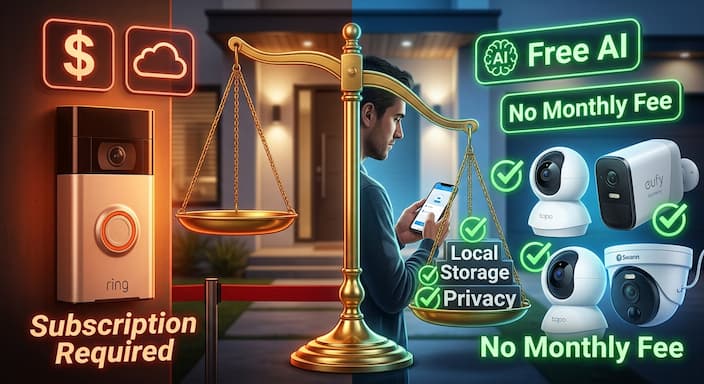
If Ring’s subscription fees have you second-guessing your smart home setup, you’re not alone. In 2026, a new wave of security cameras offers compelling features that actually outperform Ring—often without the monthly bill. Here are the best alternatives, what they do better, and the catches you need to know.
Why Look Beyond Ring?
The frustration is real. Ring locks features like person detection and video history behind a Protect plan costing $4–$10 per month. Over two years, that adds up to hundreds of dollars—on top of the hardware you already bought.
Some users also find the ecosystem increasingly invasive. Ring’s “Search Party” feature, which uses neighbors’ cameras to help locate missing pets, has raised privacy concerns, with critics calling it “expanded neighborhood surveillance”. While participation is optional, it’s pushed many to look for alternatives.
Top Ring Alternatives in 2026
1. TP-Link Tapo D210 — Best Budget Subscription-Free Pick
Price: ~$40 (chime included)
The Tapo D210 delivers a 2K (2304 x 1296) resolution, outclassing Ring’s base 1080p models. A 160° ultra-wide view captures everything from head to toe—packages included. Full-color night vision uses a built-in spotlight instead of Ring’s black-and-white infrared.
The feature that matters most: On-device AI detection is free. Person and vehicle alerts happen locally, not on a cloud server, meaning notifications are nearly instant. No subscription required.
Cons:
-
TP-Link is facing a potential US ban on its router lineup, which may give some buyers pause about its cameras
-
No end-to-end encryption
-
6-month battery life, though a $25 solar panel can make it “charge forever”
2. Eufy Security — Best for Local Storage & Privacy
Price: SoloCam E40 ~$60; Video Doorbell E340 ~$150
Eufy has positioned itself as the privacy-first brand. Most cameras store footage locally—on a HomeBase hub or built-in storage—with no cloud requirement. The SoloCam E40 offers 2K resolution at the same $60 price as Ring’s 1080p Battery Cam.
AI detection for people, vehicles, and pets is free. Some models support HomeKit Secure Video for Apple users—Ring does not.
Cons:
-
HomeBase 3 is an extra hardware purchase if you want full local storage
-
Eufy had a 2023 disclosure about cloud previews (though they’ve since patched and published independent audits)
-
Customer service is slower than Ring’s
3. Google Nest — Best for Google Ecosystem Users
Price: ~$180 (wired or battery)
Google’s third-gen Nest line upgrades to 2K resolution across the board, with a more compact design. Gemini AI powers smart detection that distinguishes between people, packages, animals, and vehicles.
Better than Ring: Nest offers 3–6 hours of free cloud video storage, plus free package recognition—no subscription required for basic recording. Also, Nest has a much stronger design and build quality than Ring’s sometimes flimsy hardware.
Cons:
-
Wired-only (AI burns through battery too fast for wireless)
-
Higher starting price than most alternatives
-
Advanced AI features require a subscription
4. Arlo — Best Premium 4K Hardware
Price: Video Doorbell 2K ~$50; premium 4K models cost more
Arlo sets the bar for image quality. The Ultra 2 4K cameras deliver stunning detail, and the doorbell offers a 180-degree viewing angle with 2K resolution.
Better than Ring: Superior wire-free image quality, advanced object detection, and Arlo’s Secure subscription includes 30-day cloud history.
Cons: The free tier is paper-thin—live view only, no recording. Arlo Secure starts at ~$8/month. If you’re trying to escape subscriptions, Arlo won’t solve that problem.
5. Blink — Best Budget Entry
Price: ~$60 (sync module bundle ~$70)
Amazon’s other brand offers an affordable entry point with head-to-toe HD view, infrared night vision, and two-way audio. Setup takes about five minutes, and battery life can stretch to two years.
Cons: Requires a Sync Module (not included) to connect to the app. Still uses a subscription for cloud storage.
6. Swann — Best for 4K + No Subscription
Price: Varies; 4K models available
Swann’s key differentiator? All cameras include local storage—microSD, NVR, or external drive—with no subscription required. Many models offer genuine 4K Ultra HD recording, far exceeding Ring’s typical 1080p.
Better than Ring: Over three years, a four-camera Ring setup could cost £400+ in fees. Swann? Zero. Also, footage stays on your property, not on third-party servers—a privacy win.
Cons: Brand recognition is lower; less integration with third-party smart home ecosystems compared to Ring’s Alexa-native setup.
7. Reolink — Best for LAN-First & PoE
Price: Budget-friendly; PoE and NVR options available
Reolink sells PoE cameras and standalone NVR boxes that record locally by default. The Argus 4 wire-free line covers the same use case as Ring’s battery doorbell, while the RLN36 NVR records 36 channels with no cloud at all.
Cons: Setup is more technical; less plug-and-play than Ring.
Quick Comparison Table
| Feature | Ring | Tapo D210 | Eufy | Nest | Arlo | Swann |
|---|---|---|---|---|---|---|
| Subscription Required? | Yes ($4–10/mo) | No | No | Free basics, paid AI | No (free is very limited) | No |
| Max Resolution | 1080p (base) | 2K | 2K–4K | 2K | 2K–4K | 4K |
| Local Storage | No (Pro models only) | Yes (microSD) | Yes (HomeBase or built-in) | Limited free cloud | No (requires subscription) | Yes (microSD/NVR) |
| Free AI Detection | No | Yes | Yes | Package only | No | Yes |
| HomeKit Support | No | No | Select models | No | No | No |
| Price (Entry) | ~$60 | ~$40 | ~$60 | ~$180 | ~$50 | Varies |
The Bottom Line
The standout replacement? The Tapo D210 offers better resolution, free AI detection, and zero subscription fees at an unbeatable $40 price point. It’s the clearest “buy it once and own it forever” option.
For privacy-focused buyers, Eufy and Swann keep your footage local and out of third-party hands. For Google ecosystem users, Nest offers premium hardware with some generous free features.
The real takeaway? You don’t have to accept Ring’s monthly lease. In 2026, there are genuinely better cameras with better features—and the freedom to keep your footage, and your money, where it belongs.