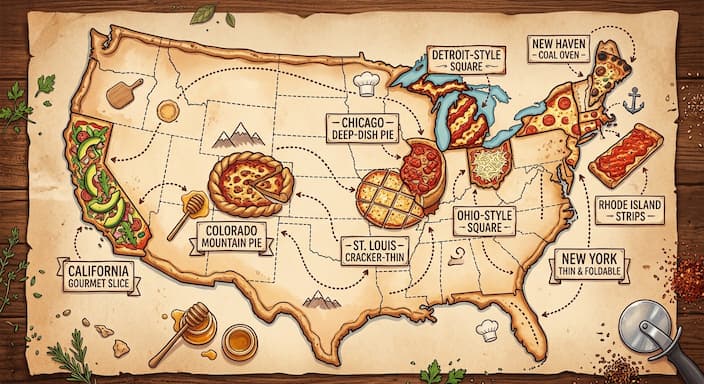
America’s pizza scene is wonderfully diverse. While pizza originated in Italy, the United States has transformed it into countless regional styles, each with its own crust, cooking method, toppings, and traditions.
From a paper-thin New York slice that you can fold in half to a massive Chicago deep-dish pie that requires a fork and knife, American pizza is anything but one-size-fits-all. Some styles are strongly connected to particular cities, while others have spread across the country and become national favorites.
Whether you prefer a crispy crust, a chewy crust, loads of cheese, unusual toppings, or a simple combination of sauce and mozzarella, there’s probably an American pizza style that matches your taste.
Here are 10 types of pizza you’re likely to encounter in the USA.
1. New York-Style Pizza
If there is one pizza style that has become synonymous with American pizza, it’s New York-style pizza.
The classic New York slice features a relatively thin, hand-tossed crust with a slightly crisp exterior and a chewy interior. The crust is sturdy enough to support plenty of sauce and cheese but flexible enough to fold lengthwise.
A traditional slice usually features tomato sauce, mozzarella, and perhaps a simple topping such as pepperoni or mushrooms. One of the defining characteristics is the balance between the crust, sauce, and cheese. Nothing is supposed to overwhelm the others.
New York pizzerias are also famous for selling pizza by the slice. This makes it an ideal food for people who want something quick and affordable without ordering an entire pie.
Why it’s iconic
New York pizza has become a symbol of urban American food culture. Walking into a neighborhood pizzeria, ordering a large slice, folding it in half, and eating it while walking down the street is practically a New York tradition.
What it tastes like
Expect a combination of:
- A crisp but foldable crust
- Tangy tomato sauce
- Melted mozzarella
- A chewy center
- Plenty of flavor from olive oil, herbs, and toppings
If you’re trying American pizza for the first time, New York-style is one of the easiest places to start.
2. Chicago Deep-Dish Pizza
Chicago deep-dish pizza is almost the opposite of New York-style pizza.
Instead of being thin and foldable, deep-dish pizza is thick, substantial, and baked inside a deep pan. The crust rises along the sides of the pan, creating a structure that looks more like a savory pie than a traditional flat pizza.
The order of the ingredients is also unusual. Cheese is generally placed directly on the dough, followed by meats and vegetables. Tomato sauce is then added generously on top.
This construction isn’t just about appearance. The thick layers of ingredients require a longer baking time, and putting the cheese underneath helps protect it from becoming overly browned during the extended bake.
Why it’s iconic
Chicago deep-dish has become one of the city’s most recognizable foods. Visitors often make a stop at a deep-dish restaurant part of their Chicago experience.
Because the pizza is so filling, a single slice can be surprisingly substantial.
What it tastes like
Expect:
- A buttery, crisp crust
- Lots of mozzarella
- Rich tomato sauce
- Meaty and vegetable fillings
- A hearty, casserole-like texture
Deep-dish is particularly appealing if you love a generous amount of cheese and sauce.
Pro tip
Don’t expect to eat it like a New York slice. Deep-dish is typically served on a plate and eaten with a fork and knife.
3. Detroit-Style Pizza
Detroit-style pizza has become one of the biggest American pizza trends in recent years.
The pizza is traditionally rectangular and baked in a deep, rectangular pan. The crust is thick, airy, and somewhat similar to focaccia, but the defining feature is the crispy cheese around the edges.
Cheese is spread all the way to the edges of the pan, where it comes into direct contact with the hot metal. As it bakes, the cheese caramelizes and develops a dark, crispy border.
Tomato sauce is often placed on top of the cheese in two or more stripes, creating the style’s famous “racing stripe” appearance.
Why it’s special
Detroit-style pizza manages to combine several textures in one bite:
- Soft and airy in the center
- Crispy underneath
- Crunchy and caramelized around the edges
- Gooey and cheesy inside
The contrast makes it particularly satisfying.
The history
The style is associated with Detroit, Michigan, where the pizza became popular in the mid-20th century. Its distinctive rectangular shape and pan-baked crust helped separate it from other American pizza styles.
Today, Detroit-style pizza can be found far beyond Michigan, with restaurants across the country creating their own interpretations.
Who should try it?
If you enjoy thick crust but still want a crispy texture, Detroit-style pizza could be the perfect compromise.
4. Neapolitan Pizza
Neapolitan pizza isn’t originally American. It comes from Naples, Italy, and is one of the world’s most influential pizza traditions.
However, it has become increasingly popular in American restaurants, particularly at pizzerias that specialize in traditional Italian cooking.
Authentic Neapolitan-style pizza is characterized by a thin center surrounded by a puffy, airy crust. It’s usually cooked at extremely high temperatures in a wood-fired or specialized pizza oven.
The intense heat cooks the pizza very quickly, producing characteristic dark spots and blistering on the crust.
Traditional toppings
Neapolitan pizza is generally minimalist. Popular combinations include:
- Tomato
- Fresh mozzarella
- Basil
- Olive oil
- Garlic
Because there aren’t dozens of toppings covering the pizza, the quality of the ingredients becomes extremely important.
The experience
Neapolitan pizza isn’t necessarily about getting the biggest or heaviest meal. It’s about appreciating the dough, sauce, cheese, and cooking technique.
The center is usually soft enough that you may need to eat it with your hands carefully or use a knife and fork.
Who should try it?
Choose Neapolitan-style pizza if you appreciate simple ingredients, fresh flavors, and a soft, chewy crust with charred edges.
5. Sicilian & Grandma Pizza
Sicilian-style pizza offers another alternative to the traditional round pie.
Instead of being stretched into a circle, the dough is generally pressed into a rectangular pan. It’s thicker and more substantial than New York-style pizza, with a soft, airy interior and a crisp, oil-infused bottom.
The result is often similar to a focaccia topped with tomato sauce, cheese, and other pizza ingredients.
Sicilian pizza is especially popular in parts of the Northeast and can frequently be purchased by the square.
What is Grandma pizza?
Grandma pizza is related to Sicilian pizza but is generally thinner and more rustic.
It is associated with the idea of homemade Italian-American cooking. The dough is often baked in an oiled pan, producing a crispy bottom while retaining a soft interior.
Grandma pizza may feature a simple arrangement of tomato sauce, mozzarella, garlic, herbs, and olive oil.
Why people love it
This style has a comforting, homemade quality.
It’s substantial without necessarily being as heavy as deep-dish pizza, making it a great choice when you want a thick, crispy-edged slice.
6. New Haven Apizza (“Ah-Beetz”)
New Haven, Connecticut, has developed one of America’s most distinctive pizza traditions: apizza.
Pronounced roughly “ah-beetz,” New Haven apizza is known for its thin, chewy crust and intense coal-fired cooking.
The high heat produces a beautifully charred exterior. Instead of trying to eliminate those dark spots, New Haven-style pizza embraces them as part of the flavor.
The legendary white clam pizza
Perhaps the most famous example is white clam pizza.
Instead of relying on traditional tomato sauce, it typically combines ingredients such as:
- Fresh clams
- Garlic
- Olive oil
- Oregano
- Grated cheese
The result is dramatically different from a conventional pepperoni pizza.
Why it’s unique
The crust is usually thin but isn’t necessarily as floppy as a New York slice. The intense oven heat produces crispness and chewiness at the same time.
The char adds a smoky, slightly bitter flavor that complements the toppings.
Who should try it?
New Haven apizza is particularly worth trying if you enjoy seafood or want a pizza experience that feels very different from the standard cheese-and-pepperoni combination.
7. St. Louis-Style Pizza
St. Louis-style pizza is one of the most distinctive regional pizza styles in the United States.
Its defining feature is the extremely thin, cracker-like crust. Unlike many other pizza doughs, the traditional crust is unleavened, meaning it doesn’t rise in the same way as conventional pizza dough.
The pizza is generally cut into small squares rather than triangular slices. This is often called a “party cut.”
Provel cheese
Another major difference is the cheese.
St. Louis-style pizza is traditionally associated with Provel, a processed cheese blend known for its smooth texture and distinctive tangy flavor.
Provel melts differently from traditional mozzarella, creating a particularly creamy consistency.
Why it’s different
If you normally prefer thick, chewy pizza crust, St. Louis pizza may come as a surprise.
Instead of a large foldable slice, you’re more likely to get small, crispy squares that are easy to share.
What it tastes like
Expect:
- A very thin, crunchy crust
- Tangy cheese
- Tomato sauce
- Small, manageable pieces
- A distinctive regional flavor
It’s about as far from a chewy New York slice as American pizza gets.
8. California-Style Pizza
California-style pizza is less about following a strict formula and more about creativity.
The style became particularly influential in the 1980s, when chefs began experimenting with pizza by incorporating ingredients that weren’t traditionally associated with Italian-American pies.
Instead of limiting toppings to pepperoni, sausage, mushrooms, and onions, California-style pizza might include ingredients such as:
- Goat cheese
- Fresh vegetables
- Avocado
- Artichokes
- Chicken
- Smoked salmon
- Arugula
- Fresh herbs
- Specialty sauces
The crust is generally relatively thin, allowing the toppings to remain the focus.
The philosophy
California-style pizza reflects the state’s broader food culture: fresh ingredients, seasonal produce, experimentation, and fusion.
A pizza might combine flavors from different cuisines or use ingredients you’d normally expect to see in a salad or upscale restaurant entrée.
The vibe
Think of California-style pizza as the adventurous side of American pizza.
It’s ideal for people who want to move beyond traditional combinations and experiment with new flavors.
9. Regional Specialties
America has so many pizza traditions that it’s impossible to cover them all with a list of major city styles.
Some regional varieties are particularly interesting because they’re relatively uncommon outside their home areas.
Ohio Valley Pizza
Ohio Valley-style pizza is associated with the Ohio Valley, particularly areas of eastern Ohio and West Virginia.
One of its most unusual features is the way cheese is handled. Cheese may be added after the pizza has been baked or near the end of the baking process, allowing it to soften without becoming completely melted.
This creates a distinctive texture and gives the pizza its own character.
Colorado Mountain Pie
Colorado is home to a pizza style designed to satisfy hungry mountain visitors.
Colorado mountain pies are known for their thick, substantial crust and large braided outer edge. Some versions can be exceptionally large.
The crust may also be served with honey, creating a sweet finish to an otherwise savory meal.
It’s particularly fitting for a region where people spend their days hiking, skiing, climbing, and exploring the outdoors.
Rhode Island-Style Pizza
Rhode Island has its own contribution to America’s pizza culture.
Rhode Island-style pizza is often rectangular and cut into strips. Some versions emphasize tomato sauce and Parmesan rather than a heavy layer of melted mozzarella.
It is a great example of how American pizza traditions can vary even between neighboring states.
Why regional pizza matters
These lesser-known styles demonstrate that American pizza isn’t simply “New York versus Chicago.”
Across the country, local communities have adapted pizza to their own ingredients, cooking traditions, and tastes.
10. Crowd-Pleasing Favorites by Topping
Not every pizza fits neatly into a regional style.
In fact, when many Americans order pizza, they’re thinking less about where the crust originated and more about which toppings they want.
Some topping combinations have become nearly universal.
Pepperoni Pizza
Pepperoni is arguably the most recognizable pizza topping in the United States.
The combination of spicy cured meat, melted cheese, tomato sauce, and crust is popular because it provides a balance of salty, savory, spicy, and slightly smoky flavors.
Pepperoni also develops crispy edges and releases flavorful oils as it cooks, making it particularly satisfying on a hot pizza.
Cheese Pizza
Sometimes simplicity wins.
A classic cheese pizza usually combines tomato sauce, mozzarella, and crust without additional toppings.
This makes it a useful way to judge the quality of a pizzeria. When there are no toppings to hide behind, the flavor of the sauce, cheese, and crust becomes much more noticeable.
Supreme or “The Works”
For people who want everything, there’s the supreme pizza.
While exact ingredients vary between restaurants, a typical supreme pizza might include:
- Pepperoni
- Sausage
- Mushrooms
- Onions
- Bell peppers
- Black olives
Some restaurants add additional meats or vegetables.
It’s essentially the “loaded” option for people who don’t want to choose between toppings.
Veggie Pizza
Vegetable pizza provides a colorful alternative to meat-heavy options.
Common toppings include:
- Mushrooms
- Bell peppers
- Onions
- Tomatoes
- Black olives
- Spinach
Some versions add broccoli, artichokes, jalapeños, or other vegetables.
The best veggie pizzas balance the moisture of the vegetables with a crust that remains crisp rather than becoming soggy.
Hawaiian Pizza
Hawaiian pizza is one of the most debated pizza combinations in America.
It typically combines ham with pineapple, creating a sweet-and-salty contrast.
Some people absolutely love it. Others strongly believe pineapple has no place on pizza.
Regardless of which side you’re on, Hawaiian pizza demonstrates how American pizza culture isn’t afraid to experiment.
How to Choose the Right American Pizza
With so many choices, it can be difficult to know where to begin.
Your preferred pizza may depend on what you like about the crust and toppings.
If you like thin and crispy:
Try:
- New York-style
- St. Louis-style
- New Haven apizza
- California-style
If you like thick and filling:
Try:
- Chicago deep-dish
- Detroit-style
- Sicilian pizza
- Colorado mountain pie
If you prefer simple, traditional flavors:
Try:
- Neapolitan
- Cheese pizza
- Margherita-style pizza
- New York-style
If you like adventurous toppings:
Try:
- California-style
- White clam apizza
- Specialty regional pizzas
If you love lots of cheese:
Try:
- Chicago deep-dish
- Detroit-style
- Sicilian pizza
- Cheese pizza
Why American Pizza Is So Diverse
One of the most interesting things about pizza in the United States is that there isn’t a single definition of what “American pizza” means.
Immigrants brought Italian culinary traditions to America, but those traditions evolved as they encountered new ingredients, cooking methods, local preferences, and business models.
Cities developed their own pizza cultures. Neighborhood restaurants developed signature recipes. Customers developed their favorite toppings. Eventually, these local traditions became recognizable regional styles.
That’s why a pizza in New York can taste completely different from one in Detroit, Chicago, New Haven, or St. Louis.
And even within the same city, two pizzerias can produce dramatically different versions of the same style.
The American Pizza Experience
Pizza in the United States is more than just a convenient meal. It’s connected to social gatherings, family dinners, sporting events, road trips, late-night meals, and local food culture.
A New York slice might be grabbed quickly during a busy day. A Chicago deep-dish meal can become a destination in itself. Detroit-style pizza might be shared among friends, while a specialty California pizza could feel like a restaurant entrée.
That’s part of what makes American pizza so appealing: it can be casual or sophisticated, inexpensive or upscale, traditional or experimental.
There is no single “correct” way to enjoy it.
Final Thoughts
From the foldable New York slice to the towering Chicago deep-dish pie, American pizza comes in an incredible variety of shapes, textures, flavors, and traditions.
Detroit gives us crispy caramelized cheese edges. New Haven brings smoky coal-fired crust and famous white clam pizza. St. Louis offers cracker-thin squares and distinctive cheese. California encourages chefs to experiment with unconventional ingredients.
And then there are the toppings that have become American classics, from pepperoni and sausage to vegetables and the famously controversial ham-and-pineapple combination.
The best part is that you don’t have to choose just one.
If you’re traveling across the United States, trying the local pizza style can be a delicious way to experience the character of each region. And if you’re staying home, there’s probably a pizzeria nearby offering a style you’ve never tried before.
So the next time you order pizza, consider going beyond your usual choice. Try a different crust, experiment with a regional style, or order a topping combination you’ve never had.
You might discover a new favorite.
After all, when it comes to pizza in America, there’s always another slice worth trying.