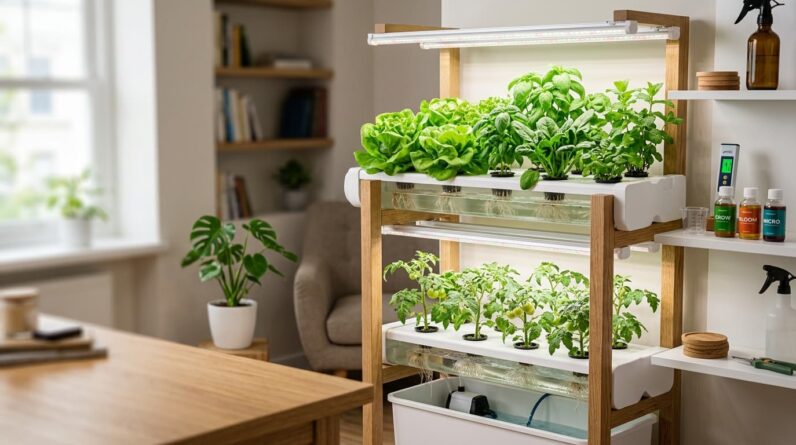
You’ve successfully grown your first batch of leafy greens. Your system runs, the pump works, the roots are developing, and you’ve managed to keep your plants healthy long enough to enjoy a harvest. Congratulations—but this is also where hydroponic gardening starts becoming much more interesting.
The intermediate stage is where you move beyond simply following nutrient-label instructions and start understanding why your plants behave the way they do.
You begin noticing that two identical plants can respond differently to the same nutrient solution. You discover that a seemingly small change in water temperature can affect root health. You learn that pH isn’t simply a number you adjust when it gets too high, and that EC isn’t a magic measurement that tells you exactly how much fertilizer your plants need.
Instead, hydroponics becomes a balancing act involving nutrients, water, oxygen, light, temperature, humidity, airflow, root health, and plant development.
The goal isn’t necessarily to build the most complicated system possible. The goal is to build a system that you understand well enough to identify problems early and make informed adjustments.
Advanced Nutrient Management: Beyond “Add and Forget”
At the beginner level, nutrient management often looks straightforward.
Fill the reservoir, add nutrients according to the manufacturer’s instructions, adjust the pH, and let the system run.
That approach can work surprisingly well for hardy crops and simple systems. But as you gain experience, you’ll discover that plants don’t consume nutrients at exactly the same rate throughout their lifecycle.
Seedlings have different requirements from established vegetative plants. A rapidly growing plant has different demands from a mature fruiting plant. Environmental conditions can also change how quickly nutrients and water are absorbed.
This means nutrient management should be treated as an ongoing observation process rather than a single calculation.
Research into controlled-environment agriculture increasingly emphasizes the importance of coordinating environmental factors such as light and nutrition rather than managing each factor independently.
EC and pH: Your Dynamic Duo
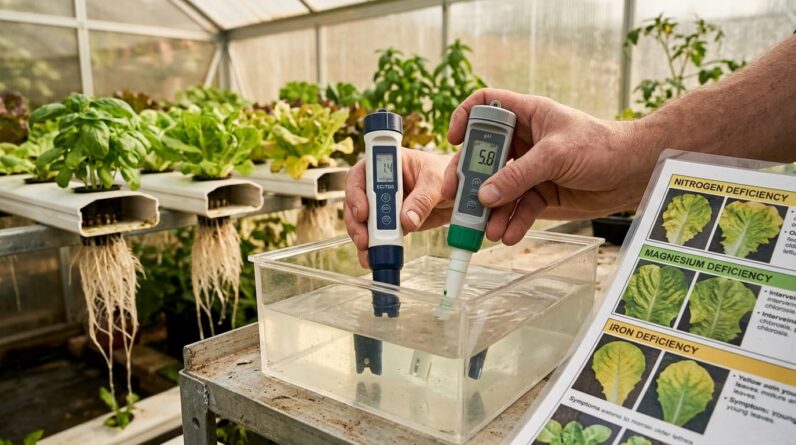
Two of the most useful measurements for hydroponic growers are electrical conductivity (EC) and pH.
EC provides an indication of the concentration of dissolved ions in your nutrient solution. It doesn’t tell you exactly which nutrients are present, but it gives you a useful picture of the overall strength of the solution.
pH, meanwhile, affects the availability of nutrients to the plant.
For many commonly grown hydroponic crops, a slightly acidic solution is appropriate, often around pH 5.5–6.5, although the ideal range depends on the crop, nutrient formulation, water chemistry, and growing system.
A commonly used target for many crops is approximately 5.8–6.3.
Example EC Ranges
These figures should be treated as general starting points rather than universal rules:
| Crop Stage | Example EC Range (mS/cm) | Approx. ppm* |
|---|---|---|
| Seedlings | 0.4–0.8 | 280–560 |
| Vegetative growth | 1.0–1.6 | 700–1120 |
| Flowering/fruiting | 1.4–2.2 | 980–1540 |
*PPM readings vary depending on whether the meter uses a 500, 640, or 700 conversion scale. EC is generally the more useful value for comparing nutrient strength.
The important lesson is that these numbers aren’t commandments.
If your particular crop performs well at a slightly different EC, forcing it toward a generic target simply because a chart says so can create more problems than it solves.
How to Interpret EC Changes
Imagine that you start the day with an EC of 1.5.
Later, you discover that the EC has increased to 1.8.
That could indicate that the plants are consuming water faster than nutrients.
On the other hand, if the EC falls substantially, the plants may be absorbing nutrients more quickly relative to water.
These trends can provide clues about what’s happening in the root zone.
However, don’t diagnose the entire system from a single measurement.
Temperature, evaporation, plant size, reservoir volume, water quality, and measurement technique can all influence your readings.
The real skill is learning to recognize trends.
Understanding pH Drift
Some degree of pH movement is normal.
Plants absorb different ions in different proportions, and those absorption patterns can influence the acidity of the nutrient solution.
Instead of constantly trying to force your reservoir to one exact number, pay attention to the direction and speed of change.
For example:
- A gradual drift may be completely normal.
- A sudden change may indicate a problem.
- Repeated large swings may justify investigating water quality, nutrient formulation, biological activity, or system contamination.
- A pH that repeatedly moves in the same direction may provide useful information about plant uptake.
Rather than asking, “How do I get the pH back to 6.0?”, an experienced grower starts asking:
“Why did the pH move?”
That change in thinking is one of the biggest differences between beginner and intermediate hydroponic gardening.
The Cleanliness Protocol: Your System’s Immune System
One of the hardest lessons for intermediate growers is that cleanliness isn’t optional.
A hydroponic system provides plants with an abundant supply of water and nutrients. Unfortunately, the same environment can support unwanted microorganisms if sanitation and environmental conditions are poorly managed.
Organic debris, dead roots, algae, stagnant water, and biofilm can all contribute to system problems.
Root pathogens such as Pythium are particularly concerning because damaged roots can quickly interfere with water and nutrient uptake.
This is why prevention is generally much easier than trying to rescue a severely compromised root system.
Why Biofilm Matters
Biofilm is a slimy layer of microorganisms and organic material that can develop on surfaces inside your hydroponic system.
You may find it around:
- Reservoir walls
- Tubing
- Pumps
- Filters
- Net pots
- Irrigation channels
- Air stones
- Fittings
Once established, biofilm can be difficult to remove completely.
Simply adding a chemical treatment may not solve the underlying problem because physical cleaning is often necessary to remove established deposits.
Think of it like cleaning a kitchen counter.
Spraying cleaner over a thick layer of dried food doesn’t eliminate the need to wipe the surface.
The same principle applies to hydroponic equipment.
A Practical Maintenance Schedule
Consistency is more important than complicated equipment.
Daily: The 10-Minute Walkthrough
Spend a few minutes inspecting your system.
Check:
- Reservoir level
- Water temperature
- pH
- EC
- Pump operation
- Air pump operation
- Leaks
- Tubing connections
- Root appearance
- Leaf color
- Plant posture
- Signs of pests
- Algae or unusual growth
You don’t necessarily need to perform a major adjustment every day.
The purpose of the inspection is to establish a baseline.
When something changes, you’ll be much more likely to notice it.
Weekly Maintenance
Once a week, perform a more detailed inspection.
Look at:
- Pump impellers
- Tubing
- Filters
- Air stones
- Irrigation emitters
- Reservoir surfaces
- Root growth
- Plant spacing
- Airflow
- Lighting position
Remove dead leaves and other organic material before they accumulate.
If your plants have become crowded, consider whether pruning or spacing adjustments are necessary for your particular crop.
Good airflow can reduce excessive humidity around foliage and improve the overall growing environment.
Monthly Deep Cleaning
Depending on the system and crop cycle, a deeper cleaning may be appropriate between growing cycles or at scheduled intervals.
A typical process involves:
- Emptying the reservoir.
- Removing plant debris.
- Disassembling accessible components.
- Physically scrubbing surfaces.
- Cleaning tubing and channels.
- Rinsing thoroughly.
- Inspecting pumps and fittings.
- Reassembling the system.
- Refilling with fresh solution.
Use cleaning agents only according to their intended application and manufacturer instructions.
Never assume that stronger concentrations are better.
And remember that physical removal of residue is often just as important as chemical sanitation.
Oxygenation: The Overlooked Essential
Many new growers focus heavily on nutrients while overlooking oxygen.
But roots need oxygen too.
Plants use oxygen for respiration, and hydroponic roots are surrounded by water rather than a naturally aerated soil environment.
If dissolved oxygen becomes too low, roots can become stressed and their ability to function efficiently can decline.
Signs of poor root-zone conditions may include:
- Wilting despite adequate water
- Brown or discolored roots
- Slimy roots
- Unusual odors
- Slow growth
- Persistent nutrient problems
- Sudden plant decline
How to Improve Root-Zone Oxygen
Several factors affect dissolved oxygen.
1. Water Temperature
Cooler water generally holds more dissolved oxygen than warmer water.
Keeping nutrient solution within an appropriate temperature range for your crop can therefore benefit root health.
Rather than chasing one universal temperature number, follow the requirements of the crop you’re growing and monitor how the plants respond.
2. Aeration
Air pumps and diffusers can increase gas exchange in systems where aeration is appropriate.
Make sure your air stones aren’t clogged and that your air pump is capable of supplying adequate airflow for your reservoir.
3. Water Movement
Good circulation helps prevent stagnant areas.
However, stronger flow isn’t automatically better.
Your goal is adequate circulation without damaging roots or creating unnecessary turbulence.
Be Careful With Hydrogen Peroxide
Hydrogen peroxide is sometimes used by hydroponic growers as part of sanitation or emergency interventions.
However, it isn’t something that should automatically be added to every reservoir.
Concentration matters, and excessive use can damage beneficial organisms as well as plant tissue.
If you’re considering peroxide, follow a crop- and product-specific protocol rather than treating it as a universal oxygen supplement.
Prevention through appropriate aeration, temperature management, sanitation, and circulation is generally preferable to repeatedly treating an unhealthy system.
Root Zone Diagnostics: Learn to Read the Signs
Your plants are constantly providing information.
Leaves, stems, roots, growth rate, water consumption, and even the reservoir itself can tell you something about system health.
The trick is learning how to interpret those signals without jumping to conclusions.
Common Symptoms
| Symptom | Possible Causes |
|---|---|
| Brown or burnt leaf tips | Excessive nutrient strength, environmental stress, or nutrient imbalance |
| Older leaves turning yellow | Nitrogen deficiency or root-related nutrient uptake problems |
| Yellow leaves with green veins | Possible iron or magnesium-related issue depending on leaf age and pattern |
| Wilting despite adequate water | Root problems, heat stress, oxygen deficiency, or circulation problems |
| Brown/slimy roots | Root-zone disease or oxygen/environmental problems |
| Slow growth | Insufficient light, nutrient issues, temperature problems, root stress, or other environmental factors |
| Curling leaves | Heat, light stress, humidity imbalance, pests, or nutrient issues |
The most important word in the table is possible.
A symptom doesn’t automatically equal a specific deficiency.
For example, yellow leaves don’t necessarily mean you should immediately add more nitrogen.
The plant may have plenty of nitrogen available, but damaged roots may be preventing effective uptake.
That’s why diagnosis should involve multiple observations.
Check the Roots Before Changing Everything
When something goes wrong, beginner growers often make several changes simultaneously.
They increase nutrients.
Then they adjust pH.
Then they change the lighting.
Then they add supplements.
Then they change the water.
Now they don’t know which change helped—or made the situation worse.
Intermediate growers learn to troubleshoot systematically.
Start by asking:
Is the root system healthy?
Then investigate:
- Water temperature
- Dissolved oxygen
- pH
- EC
- Light intensity
- Air temperature
- Humidity
- Pest pressure
- Water quality
- Recent environmental changes
Change one variable at a time whenever practical.
This makes your system much easier to understand.
Advanced System Design Considerations
As your growing experience increases, you may start looking beyond nutrients and toward the entire growing environment.
Hydroponic plants don’t grow in isolation.
The environment surrounding the system influences everything happening inside it.
Air Temperature and Humidity
Temperature affects plant metabolism, transpiration, water consumption, and root-zone conditions.
For many leafy crops, a moderate environment around 20–26°C can be a reasonable starting point, but crop-specific requirements should always take priority.
Humidity also matters.
High humidity can reduce transpiration and increase the risk of condensation and disease.
Very low humidity can increase water loss and place additional stress on plants.
The objective isn’t simply to achieve a specific humidity number.
It’s to create a stable environment appropriate for your crop and growth stage.
Understanding VPD
Vapor pressure deficit, or VPD, provides a more useful way of thinking about the relationship between temperature and humidity than looking at relative humidity alone.
Two rooms can have the same relative humidity but different VPD values if their temperatures are different.
VPD influences transpiration.
If VPD is too low, plants may transpire slowly.
If it’s too high, plants may lose water too quickly.
This is why experienced growers increasingly look at environmental conditions as an interconnected system.
Lighting and Nutrients Must Work Together
One of the most important intermediate-level concepts is that plants don’t use nutrients independently from their environment.
Light drives photosynthesis.
Photosynthesis drives growth.
Growth affects nutrient and water demand.
Therefore, increasing light intensity can potentially increase the plant’s demand for water and nutrients.
But this doesn’t mean:
“More light = automatically increase EC.”
That’s too simplistic.
Instead, increase light gradually and observe the plant.
Watch for:
- Leaf bleaching
- Tip burn
- Excessive transpiration
- Wilting
- Changes in growth rate
- Changes in water consumption
Adjust the growing environment as a system rather than treating each variable separately.
The Importance of Light Uniformity
Another consideration that becomes important as you advance is light distribution.
A powerful grow light isn’t automatically a good grow light.
If the center of your growing area receives extremely high intensity while the edges receive very little, plants may grow unevenly.
Uniformity can sometimes be more valuable than simply increasing maximum intensity.
Consider:
- Light height
- Coverage area
- Reflective surfaces
- Plant spacing
- Canopy height
- Light intensity at different locations
Taking measurements at several points across your growing area can reveal problems that aren’t obvious to the naked eye.
Advanced Technique: Ammonium-to-Nitrate Management
Nitrogen is not a single entity in a nutrient solution.
Plants can encounter nitrogen primarily in forms such as nitrate and ammonium.
The ratio between these forms can influence nutrient uptake and the chemistry of the root environment.
Research into controlled nutrient management has explored how adjusting the ammonium-to-nitrate relationship can influence pH management and plant growth.
This is a fascinating area because it demonstrates how advanced hydroponics can move beyond simply adding pH-down or pH-up.
Instead, growers can potentially influence the underlying chemistry responsible for pH changes.
However, this is an advanced technique and isn’t necessary for most home growers.
There is little reason for a hobbyist to create a complicated nutrient-control system when a properly formulated commercial nutrient solution can already produce excellent results.
The lesson is more important than the technique itself:
Advanced hydroponics is increasingly about controlling the causes of problems rather than constantly correcting their symptoms.
Water Quality: The Variable Beginners Often Ignore
Your nutrient solution begins with your water.
That means water quality can significantly influence your results.
Tap water may contain:
- Calcium
- Magnesium
- Bicarbonates
- Chlorine or chloramine
- Other dissolved minerals
These components can influence pH stability and nutrient availability.
If your tap water has high mineral content, you may need to account for it when mixing nutrients.
Should You Use Reverse Osmosis Water?
Reverse osmosis, or RO, water can provide a more consistent starting point because many dissolved minerals and contaminants are removed.
However, RO water isn’t automatically better in every situation.
It contains very few minerals, which means you may need to provide appropriate calcium, magnesium, and other nutrients through your nutrient program.
For a small hobby system, good-quality tap water may be perfectly adequate.
The important thing is to know what is in your water.
If you’re experiencing persistent nutrient or pH problems, getting a water-quality report or conducting appropriate testing may be more useful than buying another bottle of supplements.
Keep a Hydroponic Grow Journal
One of the easiest ways to become a better grower is to keep records.
You don’t need an elaborate database.
A simple spreadsheet or notebook can track:
- Date
- Crop
- Growth stage
- pH
- EC
- Water temperature
- Reservoir level
- Room temperature
- Humidity
- Light settings
- Nutrient additions
- Water changes
- Plant observations
Over time, this creates something extremely valuable:
your own growing data.
You might discover that your plants consistently consume more water during a particular growth stage.
You might notice that your pH rises more quickly when plants reach a certain size.
You may find that a particular nutrient strength works better under your lighting conditions.
Those observations become more valuable than generic advice because they’re based on your actual system.
Don’t Chase Perfect Numbers
One of the biggest mistakes intermediate growers can make is becoming obsessed with achieving perfect measurements.
You might spend an hour trying to move your pH from 6.2 to 6.0.
Meanwhile, your plants are perfectly healthy.
Remember:
The plant is the ultimate indicator.
Measurements provide information.
They don’t replace observation.
If your crop is growing vigorously, roots look healthy, leaves have good color, and the system is stable, you don’t necessarily need to make changes simply because a chart suggests your EC could be slightly different.
Numbers should help you make decisions—not make decisions for you.
Troubleshooting: Change One Thing at a Time
When something goes wrong, resist the temptation to change everything simultaneously.
Suppose your plants suddenly begin wilting.
Instead of immediately:
- Increasing nutrients
- Lowering pH
- Raising light
- Adding supplements
- Changing water
- Increasing airflow
Start with the basics.
Step 1: Check the Roots
Are they healthy?
Step 2: Check Water Temperature
Is the reservoir unusually warm?
Step 3: Check Aeration
Is the air pump working?
Step 4: Check Circulation
Is the nutrient solution moving properly?
Step 5: Check pH and EC
Are the measurements significantly different from your normal range?
Step 6: Check the Environment
Has temperature, humidity, or lighting recently changed?
This approach gives you a much better chance of identifying the real cause.
Scaling From Hobby to Serious Growing
Once you’ve mastered one small system, you may eventually want to grow more plants.
Scaling introduces new challenges.
A system that works beautifully for six plants may not behave the same way with sixty.
Larger systems require greater attention to:
- Reservoir volume
- Pump capacity
- Filtration
- Oxygenation
- Water circulation
- Temperature control
- Backup systems
- Electrical safety
- Cleaning
- Monitoring
The larger the system becomes, the more important consistency becomes.
A small mistake that affects six plants can become a major problem when it affects several hundred.
Consider Redundancy
Advanced growers should think about what happens when something fails.
What happens if:
- The pump stops?
- The air pump fails?
- The power goes out?
- A tube disconnects?
- The reservoir runs dry?
- A sensor fails?
You don’t necessarily need an expensive backup system.
Even a simple contingency plan can prevent a minor equipment failure from becoming a major crop loss.
Depending on your system, useful precautions might include:
- Spare air pumps
- Backup tubing
- Replacement fittings
- Battery backups where appropriate
- Water-level alarms
- Temperature monitoring
- Spare nutrient solution
- Emergency cleaning supplies
Key Takeaways for the Intermediate Grower
By the time you’ve reached the intermediate stage, your goal should no longer be simply keeping plants alive.
You should be developing the ability to predict, diagnose, and optimize.
Here are the most important lessons:
1. Treat pH and EC as Dynamic Measurements
Don’t obsess over individual readings.
Track trends and learn what normal looks like for your system.
2. Clean Proactively
Preventing biofilm, algae, debris, and contamination is much easier than trying to recover from a serious system problem.
3. Prioritize Root Health
Healthy roots are the foundation of a productive hydroponic system.
4. Pay Attention to Oxygen
Nutrients aren’t enough.
Roots need oxygen, appropriate temperatures, and good circulation.
5. Coordinate Light and Nutrition
Think about the growing environment as an interconnected system.
More light can change water and nutrient demand, but adjustments should be gradual and based on plant response.
6. Learn Plant Symptoms
Leaves can provide valuable clues, but don’t assume every yellow leaf represents a nutrient deficiency.
Consider the entire system.
7. Understand Your Water
Know the basic characteristics of the water you’re starting with.
It can explain many mysterious nutrient and pH problems.
8. Keep Records
Your grow journal can become one of your most valuable tools.
9. Troubleshoot Systematically
Change one variable at a time whenever practical.
10. Don’t Overcomplicate Things
Advanced doesn’t necessarily mean complicated.
A simple, stable system that you understand is often better than an elaborate system you can’t troubleshoot.
Final Thoughts
The journey from beginner to intermediate hydroponic grower is really a transition from following recipes to understanding relationships.
You begin to see that pH, EC, oxygen, temperature, humidity, light, nutrients, and root health aren’t separate subjects.
They’re connected pieces of the same system.
When light changes, plant demand can change.
When temperature rises, water consumption and oxygen availability can change.
When roots become unhealthy, nutrient uptake can change.
When water chemistry changes, pH behavior can change.
And when one variable changes, another variable may respond.
That’s what makes hydroponics both challenging and rewarding.
You don’t need to become a professional agronomist to become an excellent home grower. You simply need to become curious about why things happen.
Measure your system.
Record what you see.
Make small changes.
Observe the results.
And gradually build your own understanding of how your plants respond.
The intermediate grower doesn’t necessarily have the most expensive equipment or the largest garden.
The intermediate grower is the person who can walk into their growing area, look at the plants, check the numbers, inspect the roots, and understand what the system is telling them.
That’s when hydroponics stops being a collection of equipment and becomes a skill.
Master the fundamentals, understand the relationships, and let your observations guide your next improvement.